
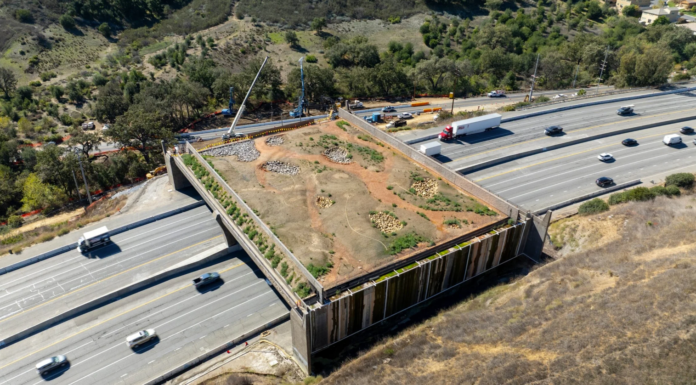
AGOURA HILLS, California — After years of construction, delays and escalating costs, officials here announced the near-completion of the world’s largest wildlife crossing this week, a sprawling vegetated overpass designed to allow animals to safely cross above the 101 Freeway and directly confront the full scale of what has been done to them.
Touted as a triumph of conservation, the structure will reconnect habitats long severed by human development, enabling mountain lions, deer and other wildlife to migrate between two carefully preserved remnants of an ecosystem that officials confirmed “used to be continuous before we cut it in half and drove cars through it for several decades.”
“This bridge represents hope,” said a spokesperson, standing beneath the overpass as traffic roared by at 80 miles per hour. “It proves we can fix anything, provided we’re willing to spend enormous amounts of money addressing a single symptom of a much larger problem we have no intention of stopping.”
The crossing, expected to open later this year, will be covered in native vegetation to create a natural environment, allowing animals to feel as though they are still in the wild while quietly being funneled across a narrow strip of land suspended above an industrial corridor of noise, pollution and irreversible decisions.
Not everyone is impressed. Critics have labeled the project a “wildlife bridge to nowhere,” pointing out that while the structure technically connects two sides of a freeway, both sides are still slowly being turned into parking.
“This is less a crossing and more a very expensive apology,” one critic said. “We fragmented an ecosystem, paved over it, and now we’re building a decorative apology ramp so animals can experience the destruction from a slightly elevated perspective.”
Supporters counter that the crossing is essential for biodiversity, reducing deadly vehicle collisions and preventing genetic isolation in species like mountain lions—who, until now, have relied on the innovative survival strategy of “don’t get hit by a car.”
The crossing includes sound barriers to shield animals from traffic noise, creating a peaceful natural corridor where wildlife can momentarily forget they are standing above a ceaseless river of human regret.
Officials emphasized that projects like this are critical as urban expansion continues to slice ecosystems into disconnected fragments. They also emphasized that, in hindsight, perhaps slicing ecosystems into disconnected fragments was not ideal.
Still, they remain optimistic.
“This is the future of coexistence,” one official said. “We build over the problem, plant some grass on it, and hope nobody asks how the problem got there.”

